
Hydration
Are you dehydrated? Facts, myths, and how to stay hydrated for optimal cognitive and physical performance.


Dehydration is a controllable risk factor that can affect your job performance, health, safety, as well as overall physical and cognitive performance. However, by learning to routinely assess your weight (W), urine colour (U), and thirst (T),you can check for dehydration throughout the day. Known as the WUT method, this practical, time-efficient, accurate tool can help measure your hydration status at home or in the field. When WUT criteria add up to 2 or 3, it’s time to rehydrate.
Water
Water is the most abundant molecule in the human body and is essential for you to function. However, your body regularly loses water through the skin (sweat), lungs (breath), kidneys (urine), and gastrointestinal tract (stool). Therefore, you need to replace it by consuming fluids (or water rich foods) to maintain the balance of water in your body.
Your hydration status changes throughout the day depending on how much fluid leaves your body versus how much fluid you take in. So, it’s important to monitor your hydration status regularly.
However water, is only one part of the equation. It is not enough to replace water to say hydrated. You also need electrolytes, as otherwise consumed water will not get into your cells.
Electrolytes
Electrolytes are electrically charged (ionised) minerals, such as sodium, potassium, or magnesium. They enable fluid transport, muscle function, and brain signalling. Think of them as the carrier that moves water into and out of cells.
Sodium is a primary driver of water balance across cell membranes. It pulls water into cells for optimal cellular health and is essential (in tightly regulated amounts) in preventing dehydration or causing it (if overdosed).
Potassium works inside cells to balance sodium, aiding in nerve impulse transmission and muscle contraction. It's essential for muscle relaxation and regulating heart rhythm, reducing risk of muscle cramps and irregular heartbeats. Fatal if overdosed.
Magnesium modulates nervous system responses and supports energy production. In states of high stress or intense physical activity, magnesium is rapidly depleted-leaving your body and mind fatigued (learn more about appropriate magnesium supplementation).
What is dehydration?
Dehydration is a process that occurs when your body loses more fluids than it can take and deliver to the cells in your body. External environment (such as hot weather) or extended periods of activity (such as working out) can greatly increase the risk of dehydration, especially through sweat loss.
To add to the challenge, sweat rates vary among individuals, making it difficult to establish a standard amount of water to maintain hydration levels. The goal for every individual is to balance fluid loss with fluid intake to maintain good hydration. It is individual to you, so the advice you might have heard on social media might not necessarily be in your best interest.
Effects of dehydration
Physical performance. Dehydration leads to increased cardiovascular stress, increased sense of effort, and decreased physical performance. When you lose more than 2%–3% of body mass due to fluid loss, your aerobic and endurance performance are significantly impaired.
Cognitive performance. Even mild dehydration (as little as 1% decrease in body mass due to fluid loss) negatively affects vigilance, attention, working memory, visual-spatial function, reaction time, and mood, and contributes to increased fatigue. Fluid losses greater than 2% lead to observable changes in brain structure and decrease skill execution, alertness, and concentration. All of this may happen before you experience the loss of physical performance.
Thermoregulation. Sweating is critical to maintain body temperature. If you don’t replace water lost through sweat (or other ways) with fluids, dehydration results, decreasing your body's ability to sweat and regulate its temperature (“thermoregulate”). Losing more than 2% of body mass due to fluid loss reduces your ability to sweat and increases the risk of heat exhaustion.
Occupational performance, safety, workplace success. Decreases in physical and cognitive performance are likely to affect job-related duties and outcomes.
Did you know the technical terms to describe differences in hydration status?
Dehydration and rehydration - describe processes of loosing and gaining body water, respectively
Hypohydration - state of having low body water. It is not the same as dehydration (dehydration occurs all the time; hypo hydration is the consequence of not having your electrolytes and water replenished sufficiently).
Euhydration - state of having adequate water and electrolyte levels
Hyperhydration - states of excess body water (likely leading to electrolyte loss)
How to tell if you’re dehydrated?
Most methods to assess hydration status require advanced laboratory techniques or equipment and aren’t practical in most settings. However, a combination of three easy-to-collect measurements (weight, urine, and thirst) in a “Venn diagram” decision tool (see below) can be used to accurately measure hydration status.
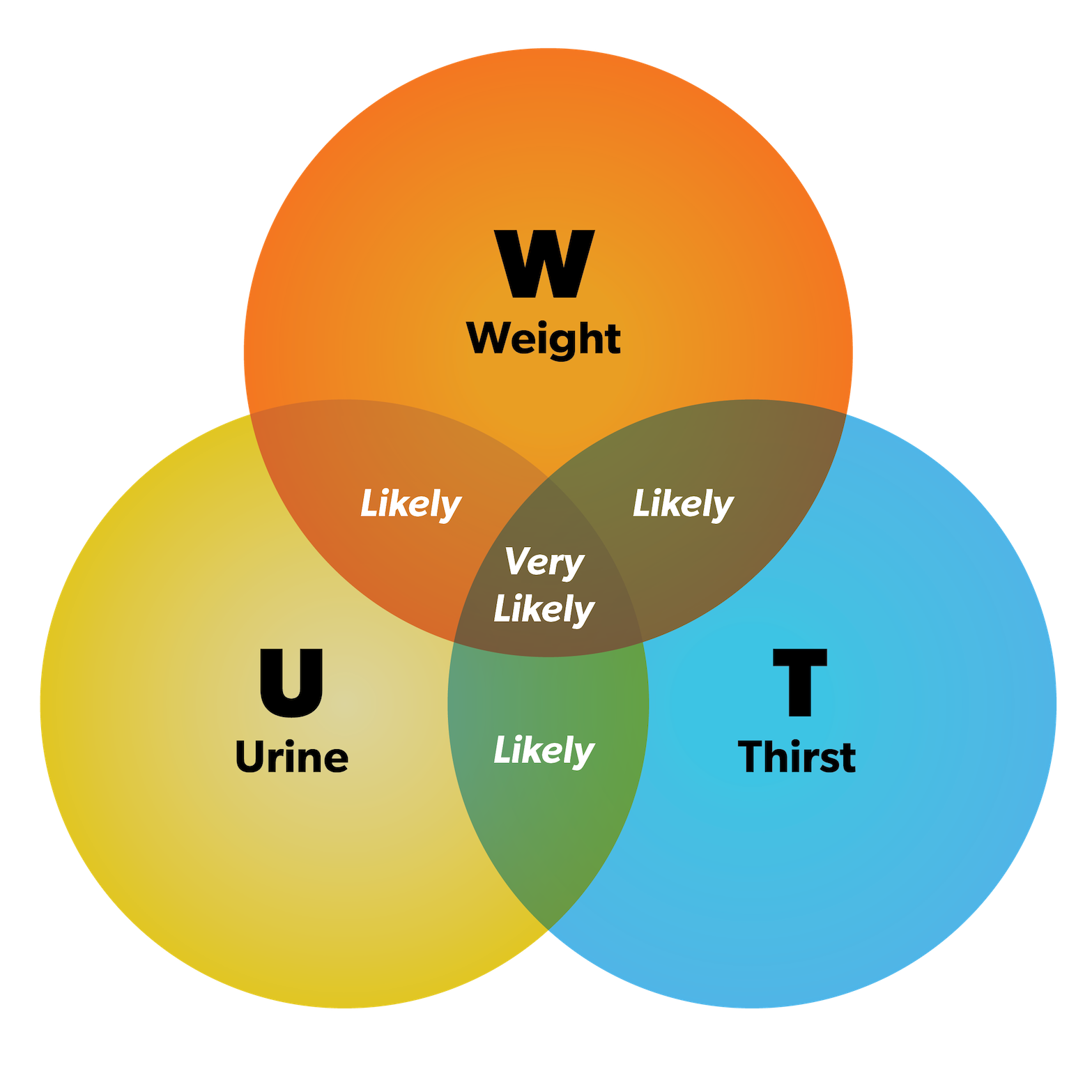
This method is proven to be comparable to hydration measures used in laboratory settings. Known as the WUT method, this model is now widely used for healthy, active, low-risk individuals to self-monitor their day-to-day hydration status.
No single marker is a true reflection of hydration status, but research indicates that testing positive for 2 or 3 of the WUT markers is a valid indicator of dehydration.
(W)eight - check the scale
“W” refers to percent (%) loss of body mass (weight). Monitoring your body mass is a simple, noninvasive, valid method to assess hydration status when you aren’t trying to gain or lose weight. When you replace water losses throughout the day, your body weight should change less than 1%.
Therefore, 1% or more of weight loss is a marker of dehydration and counts as “1” in the WUT criteria.
To find 1% of your body weight, divide it by 100 (or multiply it by 0.01). For example, for a 90kg male:
90 kg / 100 = 0.9kg of weight loss (or 90 kg * 0.01 = 0.9 kg of weight loss)
(U)rine - check your urine
“U” refers to changes in urine color. When you’re well hydrated, normal urine color is “very pale yellow,” “pale yellow,” or “straw-colored”—numbers 1, 2, or 3 on an 8-color urine scale (see below).

Urine colour darker than 5 is a marker of dehydration and counts as “1” in the WUT criteria. Decreases in urine volume and urinating less often (more than 4 hours between visits to the toilet) are also indications of dehydration.
For the WUT method to be a valid tool for medical professionals to assess and identify dehydration, urine colour should be assessed undiluted (such as in a urine-collection cup) and then compared against the 8-colour urine colour chart developed by L. Armstrong1.
(T)hirst: Ask yourself if you are thirsty?
“T” refers to a conscious desire for water—thirst. If, like many people, you have learned to override internal body cues and ignore feelings of thirst, it’s time to reconnect your mind with your body.
When using the WUT method, thirst is assessed on a scale of 1 to 9, where 1 is “not thirsty at all,” 3 is “a little thirsty,” 5 is “moderately thirsty,” 7 is “very thirsty,” and 9 is “very, very thirsty.”
A thirst level of 5 or more is a marker of dehydration and counts as “1” in the WUT criteria.
Preventing dehydration using the WUT method
You can use the WUT method daily to assess changes in hydration status. To get started, measure your weight 3 days in a row (under the same conditions) to get an accurate baseline body weight.
It’s very important to weigh yourself at the same time each day, after urination, and naked (or if not possible - in the same or very comparable clothing). Choose a time and conditions that work for you and be consistent. Do you weigh yourself first thing in the morning, after using the toilet, with no clothing? Great! Keep those conditions similar for accurate baseline body-weight assessment. Or do you weigh yourself between 1500–1600 regularly, after voiding, in sporting clothing before you hit the gym? Wonderful! Keep those conditions the same.
Now that you have an idea of your baseline body weight, you can watch for changes in body weight from day to day (still under same conditions). Whenever you assess your weight, be sure to consider your urine color and feelings of thirst too. This way, you can use the WUT method on a regular basis to assess hydration status and help determine if you need to consume more fluids.
Prevent dehydration using the WUT method for activities and events
Once you know your baseline body weight, you can also use the WUT method before, during, and after activities to determine if and when you need fluids to optimise your performance for specific events.
Run through the WUT method about 4 hours before your activity to determine if you need more fluids to begin well hydrated. This gives you enough time to slowly drink fluids before the activity begins. This is particularly important if you know that you won’t have access to fluids during the activity. Consuming fluids with sodium, handful of salted nuts, or small meals with salt can help you retain fluids and optimise your hydration status (replenish water and electrolytes). Contrary to the popular belief, drinking shortly before the planned activity is not enough to increase performance if you are dehydrated, as water and minerals need time to be absorbed and distributed to cells.
During activity, you may not be able to monitor body-weight changes. However, you can continue to assess feelings of thirst (T), and you may be able to assess urine colour (if the activity is long enough and allows for bladder relief). These 2 WUT criteria can help you make hydration decisions throughout prolonged activity. As a standard practice, continue to take small sips of fluid throughout the activity to help minimise changes in urine colour, body weight, and feelings of thirst during the activity:\
For exercise lasting up to one hour:
Drink: water only
When: 100-250ml (3-8 oz) every 15-20 minutes
For exercise lasting longer than one hour
Drink: water, carbs, and electrolytes ONLY if the effort is extreme (marathon, heavy mining work, soldier combat training). Sports drinks should contain (per 250ml or per 8oz):
Carbs: 10g carbs (up to 20g if activity is extreme)
Sodium: 50 mg (up to 200mg in prolonged, multi hour strenuous activities, like a marathon)
Potassium: 20mg (up to 100 mg in extreme, prolonged effort)
When: 100-250ml (3-8oz) every 15-20 minutes
NOTE: the vast majority of people should hydrate with water only!
After the activity, use the WUT method again to assess your hydration status, and rehydrate if necessary. If you retain proper hydration levels by consuming fluids during activity, then no specific rehydration strategies are needed.
Keep in mind, if you gained weight during the activity, you might be consuming too much fluid. However, if your WUT criteria add up to 2 or 3 after activity, it’s time to rehydrate.
Normal activities - such as walking, non-competitive running, social sporting activities (football, tennis, basketball) - require only water, regardless of their duration.
What do I do if I’m dehydrated?
Rehydrate! Your goal is to replace any water AND electrolytes lost. Changes in body weight that reflect fluid loss can be used to calculate fluid-replacement needs at that time.
If dehydration isn’t severe, and time permits, you can slowly consume normal meals and fluids to restore your hydration status over time. However, if recovery time is short (less than 12 hr), you can rehydrate by consuming about 1.5 litres of fluid for each kilogram (20–24 ounces for each pound) of body weight lost during activity.
Consuming carbohydrates and electrolytes with rehydration fluid can help stimulate your thirst, retain fluid, and promote rehydration.
Caution! Don’t drink more than you need. If you consume too much fluid, hyponatremia (low sodium levels in the bloodstream) can occur, and it is dangerous! As sodium levels in the bloodstream fall, you could experience symptoms such as headache, vomiting, fatigue, confusion, and disorientation. As the condition worsens, it could lead to cerebral oedema (swelling of the brain) with seizure, coma, and even death.
Know when to ask for help
If dehydration continues without correction, you could develop more severe signs or symptoms, such as flushed skin, apathy, dizziness or lightheadedness, nausea, diarrhea or vomiting, chills, headache, gastrointestinal cramping, and discomfort.
When weight loss due to dehydration is more than 2%, the effects on physical and cognitive performance may become more apparent. Understanding the signs of dehydration, in daily life and during exercise, can help you correct fluid balance with rehydration strategies to improve performance and reduce risk.
Fluid losses and needs vary a lot from person to person. Characteristics such as body weight, genetics, sex, body fat, heat acclimatisation, type and intensity of activity, differences in clothing, and environmental conditions, lead body mass can all impact fluid loss.
Therefore, what’s “right” for you may not be “right” for the person sitting next you. Regularly assessing your WUT and referring to the this article can help you stay on top of your hydration status and fluid needs.
References
Adams, W. M., Vandermark, L. W., Belval, L. N., & Casa, D. J. (2019). The utility of thirst as a measure of hydration status following exercise-induced dehydration. Nutrients, 11(11), article 2689. doi:10.3390/nu11112689
Adan, A. (2012). Cognitive performance and dehydration. Journal of the American College of Nutrition, 31(2), 71–78. doi:10.1080/07315724.2012.10720011
American College of Sports Medicine, Sawka, M. N., Burke, L. M., Eichner, E. R., Maughan, R. J., Montain, S. J., & Stachenfeld, N. S. (2007). Exercise and fluid replacement. Medicine & Science in Sports & Exercise, 39(2), 377–390. doi:10.1249/mss.0b013e31802ca597
Armstrong, L. E., Maresh, C. M., Castellani, J. W., Bergeron, M. F., Kenefick, R. W., LaGasse, K. E., & Riebe, D. (1994). Urinary indices of hydration status. International Journal of Sport Nutrition, 4(3), 265–279. doi:10.1123/ijsn.4.3.265
Barnes, K. A., Anderson, M. L., Stofan, J. R., Dalrymple, K. J., Reimel, A. J., Roberts, T. J., . . . Baker, L. B. (2019). Normative data for sweating rate, sweat sodium concentration, and sweat sodium loss in athletes: An update and analysis by sport. Journal of Sports Sciences, 37(20), 2356–2366. doi:10.1080/02640414.2019.1633159
Cheuvront, S. N., Carter, R., Montain, S. J., & Sawka, M. N. (2004). Daily body mass variability and stability in active men undergoing exercise-heat stress. International Journal of Sport Nutrition and Exercise Metabolism, 14(5), 532–540. doi:10.1123/ijsnem.14.5.532
Cheuvront, S. N., & Kenefick, R. W. (2014). Dehydration: Physiology, assessment, and performance effects. Comprehensive Physiology, 4(1), 257–285. doi:10.1002/cphy.c130017
Cheuvront, S. N., & Kenefick, R. W. (2016). Am I drinking enough? Yes, no, and maybe. Journal of the American College of Nutrition, 35(2), 185–192. doi:10.1080/07315724.2015.1067872
Ganio, M. S., Armstrong, L. E., Casa, D. J., McDermott, B. P., Lee, E. C., Yamamoto, L. M., . . . Lieberman, H. R. (2011). Mild dehydration impairs cognitive performance and mood of men. British Journal of Nutrition, 106(10), 1535–1543. doi:10.1017/s0007114511002005
Gunawan, A.A.S., Brandon, D., Puspa, V.D., & Wiweko, B. (2018). Development of urine hydration system based on urine color and support vector machine. Procedia Computer Science, 135, 481–489. doi:10.1016/j.procs.2018.08.200
Keefe, M. S., Luk, H.-Y., Rolloque, J.-J. S., Jiwan, N. C., McCollum, T. B., & Sekiguchi, Y. (2023). The weight, urine colour and thirst Venn diagram is an accurate tool compared with urinary and blood markers for hydration assessment at morning and afternoon timepoints in euhydrated and free-living individuals. British Journal of Nutrition, 131(7), 1181–1188. doi:10.1017/s000711452300274x
Lindseth, P. D., Lindseth, G. N., Petros, T. V., Jensen, W. C., & Caspers, J. (2013). Effects of hydration on cognitive function of pilots. Military Medicine, 178(7), 792–798. doi:10.7205/milmed-d-13-00013
Manning, E. P., & Wilson, B. (2007). Dehydration in extreme temperatures while conducting stability and support operations in a combat zone. Military Medicine, 172(9), 972–976. doi:10.7205/milmed.172.9.972
McCubbin, A. J., Allanson, B. A., Caldwell Odgers, J. N., Cort, M. M., Costa, R. J. S., Cox, G. R., . . . Burke, L. M. (2020). Sports Dietitians Australia Position Statement: Nutrition for exercise in hot environments. International Journal of Sport Nutrition and Exercise Metabolism, 30(1), 83–98. doi:10.1123/ijsnem.2019-0300
McDermott, B. P., Anderson, S. A., Armstrong, L. E., Casa, D. J., Cheuvront, S. N., Cooper, L., . . . Roberts, W. O. (2017). National Athletic Trainers' Association Position Statement: Fluid replacement for the physically active. Journal of Athletic Training, 52(9), 877–895. doi:10.4085/1062-6050-52.9.02
Nunneley, S. A., Dowd, P. J., Myhre, L. G., Stribley, R. F., & McNee, R. C. (2007). Tracking-task performance during heat stress simulating cockpit conditions in high-performance aircraft. Ergonomics, 22(5), 549–555. doi:10.1080/00140137908924639
Rodriguez, N. R., DiMarco, N. M., Langley, S., American Dietetic Association, Dietitians of Canada, & American College of Sports Medicine: Nutrition and Athletic Performance. (2009). Position of the American Dietetic Association, Dietitians of Canada, and the American College of Sports Medicine: Nutrition and athletic performance. Journal of the American Dietetic Association, 109(3), 509–527. doi:10.1016/j.jada.2009.01.005
Sawka, M. N., Cheuvront, S. N., & Kenefick, R. W. (2015). Hypohydration and human performance: Impact of environment and physiological mechanisms. Sports Medicine, 45(S1), 51–60. doi:10.1007/s40279-015-0395-7
Sawka, M. N., Montain, S. J., & Latzka, W. A. (2001). Hydration effects on thermoregulation and performance in the heat. Comparative Biochemistry and Physiology Part A: Molecular & Integrative Physiology, 128(4), 679–690. doi:10.1016/s1095-6433(01)00274-4
Sekiguchi, Y., Benjamin, C. L., Butler, C. R., Morrissey, M. C., Filep, E. M., Stearns, R. L., . . . Casa, D. J. (2021). Relationships between WUT (body weight, urine color, and thirst level) criteria and urine indices of hydration status. Sports Health: A Multidisciplinary Approach, 14(4), 566–574. doi:10.1177/19417381211038494
Streitbürger, D.-P., Möller, H. E., Tittgemeyer, M., Hund-Georgiadis, M., Schroeter, M. L., & Mueller, K. (2012). Investigating structural brain changes of dehydration using voxel-based morphometry. PLoS ONE, 7(8), article e44195. doi:10.1371/journal.pone.0044195
Armstrong, L. E., Maresh, C. M., Castellani, J. W., Bergeron, M. F., Kenefick, R. W., LaGasse, K. E., & Riebe, D. (1994). Urinary indices of hydration status. International Journal of Sport Nutrition, 4(3), 265–279. doi:10.1123/ijsn.4.3.265