
On Air
Light bulb moments for health and clarity.


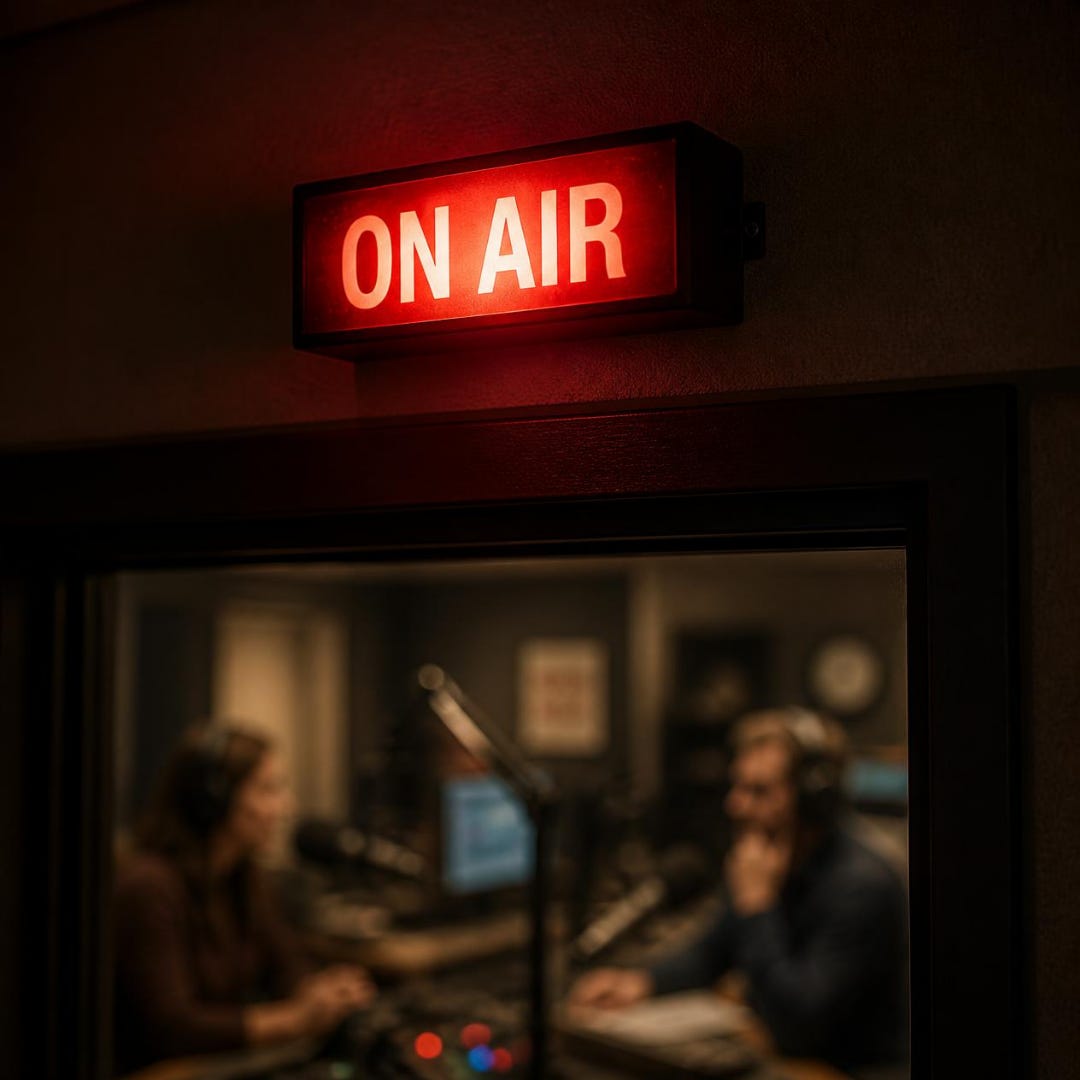
Picture this - two teenage boys in a small, padded, soundproof room. It is the middle of the night in the middle of nowhere, Ohio. The moment we lock the door, the lamp outside comes on.
Mitch is on the phone. Every 20 minutes or so, he writes down the next song and album and passes it to me. I go find it, look at the back of the tape, rewind it to that song using a machine, and then hand it over to Mitch who puts it in the cassette slot and presses play. And that’s how someone could request special songs on the WLGC local radio station.
Maybe they liked the music, or they were on a date, or wanted to surprise someone. We were (half) joking that we were helping horny people get laid. At least, I don’t think people were celebrating their Dad’s birthday with radio-ordered love ballads at 2 am.
We were on an important mission to help our fellow men (and the occasional lady) of the night.
The reason I took this job was because it started between 8 and 10 pm, so I could still socialise and do activities after school. It paid twice as much money as what my friends made working at Wendy’s, plus it was the night shift, plus the work was super easy. It was 30 seconds of focused work every 20 minutes or so. And it was less and less work later in the night it got.
So after school, I’d go and spend 6 hours locked in that room. I would leave at 4 am so that Mitch could pass off the morning shift to the “real” radio people. I’d get a few hours of sleep and get back to school in the morning.
Besides the money and the unique experience, it was also a perfect job for me because at the age of 16, I was obsessed about sleep. I mainly believed sleep is a waste of time. And life.
Why would I sleep when I could be reading, learning, or experiencing other things? I started researching and playing with sleep schedules to know how to function with as little sleep as possible.
And I stayed obsessed with this for a while. I remember planning a trip to Iceland for a summer because there would be virtually 24 hours of sunlight, and I wanted to see as much as I could while sleeping as little as possible.
This attitude carried over through school, university, and was reinforced by the environment when I went into ENT / surgical training.
The doctors who slept were considered weak or lazy or unimportant. Not sleeping was normalised, it was a sort of a badge of honour.
Even if people knew that rest is needed, because it is safer for you and your patients, they still didn’t do it. Sleeplessness was just part of the job. I tried to maintain this image, this toughness, my sharpness. I never told the people I worked with I would sleep in between shifts in the car of the back of a cinema. They thought I was running errands or “being productive” in that time.
Another irony is that I operated on patients with sleep apnea, seeing how their lack of sleep makes them accident prone, hearts weaker, decisions poorer…
But for some reason I didn’t believe then that voluntarily cutting down on sleep could (did) have the same impact on me.
I fell asleep behind the wheel at a red light once. My ability to provide excellent care was compromised. I snapped at my kids and colleagues for trivial reasons.
I was lucky nothing serious happened. I just didn’t want to connect the dots.
At that time, I didn’t know how my health, judgments, or decisions were impaired. And trust me, I made plenty of stupid decisions when I was younger. But those tiny, accumulated judgments (or lack of) over time add up.
It took me 20 years to fully understand that cutting sleep cut REM, the important restorative part.
I did know, but I chose to ignore it until the price became my health, my relationships, and my patients’ safety. I could see it in others, but chose not to see it in myself.
So, it’s 4 am. I close the door to the radio room. The On Air light is on again. Mitch stays, and I somehow get myself back to get a few hours of sleep before I do the whole thing over again…
The first time I flew business class was when I was a month into a new role with a small pharmaceutical company I was recruited into I was being sent to Germany on a very comfortable Lufthansa flight and it was spectacular. I got lucky with the stranger next to me, Wolff, who was traveling from NYC to visit his mother for her 99th birthday.
We just clicked. We chatted and enjoyed the flight. We talked about the history of the Lufthansa airline, how he and his wife always visit MoMA on New Year’s Day, the time his corgi got sprayed by a skunk and rolled around their bedroom carpet. And since he was German, he could ask the stewardesses for a bit more cheese and port wine to accompany our conversation. We did not take the hint after they dimmed the lights and kept chatting until we finally both agreed it was maybe a good idea to get some sleep. Wolff took half an Ambien, and I finished my nth glass, and then we both had a hell of a time running through the Frankfurt airport to find our connecting gates the next morning on a few hours of sleep.
I showed up to the site the following day, professional and functional as always, but there was this dim little light bulb flickering in the back of my mind, like, I could tell some of my judgments were not quite up to par with the interrupted sleep. I was in a new country, I needed to drive (in Germany!), move an important project along with a new team, secure my own professional future. You know, all those tiny little things that really benefit from “a good night’s sleep”.
Since then, almost a decade ago now, I have become very aware of how substances and sleeping pills actually effect major decisions, health, relationships, and all those other daily choices in between. Not just for myself, but for many others too.
Putting people in an MRI scanner now has shown me how those judgments work at a level we’re often unaware of, and how much of an impact non-physiological sleep has on how we think and regulate our emotions and make decisions. How we move, how we exercise, how we eat, what we eat, how we think about ourselves, how we take care of others, how we work, how we play.
Maciej knew all about the consequences of sleep impairment in the patients he was treating. But completely unable to see the consequences of that with what he was doing voluntarily for himself. It’s part of being human. Your brain will not help you see those things in yourself the same way. It often takes someone else for that to become clear.
Now, I don’t know about Wolff, but I knew that if I want to get anywhere even close to 99, it wouldn’t happen with alcohol. It took me a long time to understand that falling asleep faster after a pill or glass of wine seemed like sleep was okay, but it was also robbing me of the physiological (natural) sleep and restorative REM. Duration is just one aspect of sleep; it needs the correct architecture too.
And for me that’s when that flickering light bulb in the back of my mind finally switched On Air.

Read On:


