
Verdict before the trial
My daughter was 6 years old when she taught me I was a liar. The kind who lies to himself and calls it being objective.


It was a Tuesday. She wanted another blue squishy toy. The ones with the soft memory foam insides and cute big eyes. I didn’t like them. They only collect dust. She doesn’t play with them. She already had 28 similar ones. And they cost f*cking £40!
For something that will end up on a landfill after a decade of collecting dust mites that give my dog and my wife sinusitis. So I did the ”responsible” thing…
I gathered evidence: “You already have tons of them,” I said. “You never play with them anyway. You can have a similar one for a fraction of the price. They will end up in a landfill, and they are terrible for the environment.” (Well, the last sentence isn’t even mine, it’s what my wife keeps saying to our daughter).
Every word, however, was true. Yet every word was also a lie… Because I had already decided. I decided the second I saw the price tag. Everything after that was me building a case.
She looked up at me and said ”Daddy, you’re not thinking. You’re arguing.”
So I bought another useless plushie.
Brain Trap
Here is the uncomfortable shit: What I did that Tuesday is our brains’s default setting.
We like to think decisions work like this: You gather facts, you weigh them, and then you choose. It feels clever. Rational even.
But it is bullshit.
Most of the time it runs backwards: You “choose” first. Then you go looking for facts that agree with you. This is called confirmation bias, and it happens all the time. You do not analyse; you rationalise.
And the two feel identical to your brain.
That is the trap. Real analysis (using analytical tools, such as KAC, QIC, ACH, etc.) and fake analysis (what we do by default) are deceptively similar. Both involve reasons. Both sound clever. Both make you feel like a thinker. But only one of them is real.
Your brain on a decision it has already made
Hard to believe it? We can watch this process happening live inside a living brain.
In 2004, a team led by psychologist Drew Westen sat committed political partisans inside a fMRI brain scanner. He showed them embarrassing, contradictory statements from their own favourite candidate. Then from the rival (Westen et al., 2006).
Cold logic would light up the reasoning parts of the brain. That is not what happened. They wrote that: “Motivated reasoning is a form of implicit emotion regulation in which the brain converges on judgments that minimize negative and maximize positive affect states.”
In plain English: their brains did not do any reasoning. They soothed feelings. The researchers found that the brain areas responsible for reasoning DID NOT show increased activity as participants drew their conclusions.
Read that again. When people defended their guy, the reasoning switched off. The emotional machinery lighted up. Then, once they reached the emotionally comfortable conclusion, the reward circuits gave them a little hit of chemical pleasure.
Your brain (by default) rewards you for lying to yourself.
That was me and the plushies. That is you and your car purchase. The emotional decision came first. The reasons justified it later, pretending to be logic, making you feel good, but making your decision wrong.
Here is how this messes up your life
This default behaviour that we are not even aware of leaks into everything we do every day.
It happens at work: You have already decided to hire her. You liked her in the room. So when the reference check coughs up a red flag (after the 5 you ignored in the interview) you explain it anyway. “Every workplace has politics.” “Her last boss sounds difficult.” You are not evaluating the evidence. You are defending the automated decision.
It happens at home. You have already decided to buy the thing. The car. The kitchen. The holiday. So you stop counting the real cost, and start making up reasons. “We deserve it.” “It’ll last for years.”
It happens in relationships. You have decided to trust him, and ignored the signals, the red flags, the story that did not add up. “I’m probably overthinking.” No. You are not reading the person in front of you. You are protecting the decision behind you. Because you want to feel something. And this is not a smart thing to do.
In each case the same shit has happened. Rational analysis has been replaced by emotional reasoning impersonator. And the impersonator is very, very good at its job.
Kill your assumptions
Good intelligence analysts are trained to do something that feels deeply unnatural. Before they argue for a conclusion, they try to kill it first.
They ask a brutal question. “What would need to be true for me to be wrong?” Then they go looking for exactly that. Not to feel clever, but to avoid being fatally stupid.
The core of that method is simple. The goal is the truth, not the win. Those are different targets. Most of us aim at the second but pretend it’s the first.
Winning feels like being right. It is not the same thing. Before you defend any decision, try to kill it. Say the strongest case against it out loud. Ask yourself the six-year-old’s question. Am I thinking? Or am I arguing?
A plot twist
Every good substack post needs a plot twist, or at least that’s what I have been told. You might now be thinking the answer is simple. Strip out the emotion. Become a machine. Pure cold logic!
But that does not work either. And the proof is one of the saddest stories in neuroscience.
Antonio Damasio had a patient named Elliott. A tumour damaged a specific patch of Elliott’s frontal lobe. His IQ stayed sky high. His memory, his language, his logic, all intact (Damasio, 1994). One thing changed: he stopped feeling.
You would think that makes him a decision-making god. Emotions out, pure reason in. But that did not happen: “Elliott emerged as a man with a normal intellect who was unable to decide properly (…) Making an appointment took 30 minutes, choosing where to eat lunch took all afternoon, even deciding which colour pen to use became an impossible struggle”.
Damasio watched him weigh a simple decision: “what will you have for lunch?” Elliot listed every factor, for and against, for two and half hours, and still could not choose.
“Without emotion to guide him, he was paralysed by choice in a world with too many variables for pure reason to process.”
That is decision paralysis - too much unfiltered information preventing you from taking the next step.
The recipe for a good decision
Let’s put the two side by side: Let the emotions in, and you get me with the plushies: the decision first, the facts bent to fit. We call it emotional reasoning - and our brain rewards us for it.
Zero emotions and you get Elliott. Endless analysis, zero decisions. A genius starving in grocery store.
Emotion is not the enemy of good thinking. Without it you cannot even start. But if you let the emotions drive the decision, you end up making mostly wrong calls while feeling great.
The key is recognising when your gut gets involved and using structured tools and processes to not let it take over.
Your gut is needed to make the call, but it is a terrible guide. It is almost always wrong, while always making you feel good and rewarding you with dopamine. A good decision maker is someone who is able to rapidly cross-examine their feelings before you let them pass the verdict.
What I do now
Here is a simple rule I follow: 3 simple questions.
Have I already decided?
What would prove me wrong?
What specifically is my gut feeling protecting or hiding?
Three questions. It takes less than 5 seconds. Memorise them now. They have saved me from bad hires, buying shit I never needed, or doing business with people I felt good about, but knew deep down knew I shouldn’t.
Who was right?
The dog ripped the memory foam from the plushie the next Saturday. My daughter changed her favourite colour to green two weeks later. The toy went to trash, exactly as I predicted.
I was “right”. Yet it does not matter.
Why? Because I was right by accident, for the wrong reasons, having done no thinking at all. You can get your outcomes from bad decisions, just as much as you can get into trouble from good calls.
My “correctness” was a coincidence, and coincidence is not a strategy. It will make you lose in the long run. Which kind of matters in a world where outcomes of our decisions compound as we go through life.
The plushies were never the point. The point was a 6 year-old catching her father not arguing, but deceiving him self that he was reasoning.
Sometimes you need another person’s input to examine your own shortcomings. And that’s why we are starting something new…
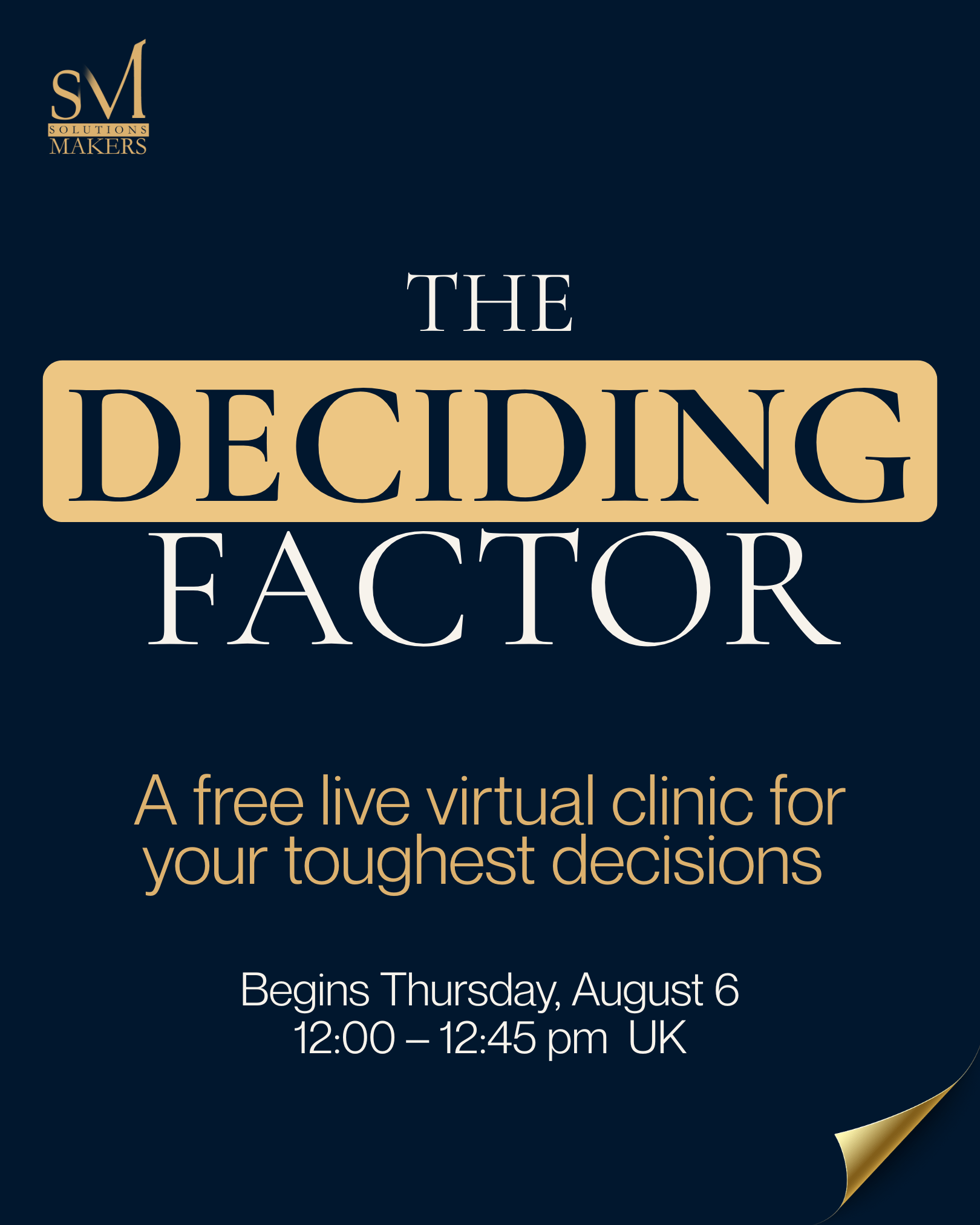
Join us for The Deciding Factor, a live decision-making session twice a month on our private Zoom. Bring a decision you’re grappling with at work or in life, and we’ll teach you decision-making tools for your real life.
The first session is Thursday, August 6th. We open the room at 12 pm BST / 7 am EST. Bring your lunch or breakfast and drop in!
*Damasio is one of the world’s most distinguished pioneers in emotions and cognition; start here
References
Bechara, A., Damasio, H., Tranel, D., & Damasio, A. R. (1997). Deciding advantageously before knowing the advantageous strategy. Science, 275(5304), 1293–1295.
Damasio, A. R. (1994). Descartes’ error: Emotion, reason, and the human brain. G. P. Putnam’s Sons.
Dunn, B. D., Dalgleish, T., & Lawrence, A. D. (2006). The somatic marker hypothesis: A critical evaluation. Neuroscience & Biobehavioral Reviews, 30(2), 239–271.
Heuer, R. J., Jr. (1999). Psychology of intelligence analysis. Center for the Study of Intelligence, Central Intelligence Agency.
Iyengar, S. S., & Lepper, M. R. (2000). When choice is demotivating: Can one desire too much of a good thing? Journal of Personality and Social Psychology, 79(6), 995–1006.
Kunda, Z. (1990). The case for motivated reasoning. Psychological Bulletin, 108(3), 480–498.
Lerner, J. S., Li, Y., Valdesolo, P., & Kassam, K. S. (2015). Emotion and decision making. Annual Review of Psychology, 66, 799–823.
Lord, C. G., Ross, L., & Lepper, M. R. (1979). Biased assimilation and attitude polarization: The effects of prior theories on subsequently considered evidence. Journal of Personality and Social Psychology, 37(11), 2098–2109.
Nickerson, R. S. (1998). Confirmation bias: A ubiquitous phenomenon in many guises. Review of General Psychology, 2(2), 175–220.
Nisbett, R. E., & Wilson, T. D. (1977). Telling more than we can know: Verbal reports on mental processes. Psychological Review, 84(3), 231–259.
Scheibehenne, B., Greifeneder, R., & Todd, P. M. (2010). Can there ever be too many options? A meta-analytic review of choice overload. Journal of Consumer Research, 37(3), 409–425.
Westen, D., Blagov, P. S., Harenski, K., Kilts, C., & Hamann, S. (2006). Neural bases of motivated reasoning: An fMRI study of emotional constraints on partisan political judgment in the 2004 U.S. presidential election. Journal of Cognitive Neuroscience, 18(11), 1947–1958.